
Chain, Belt or Wall-Mount Openers
Chain-drive, belt-drive, or wall-mount — the right opener depends on your door, your ceiling, and what's on the other side of that garage wall. Here's how I walk homeowners through the decision.
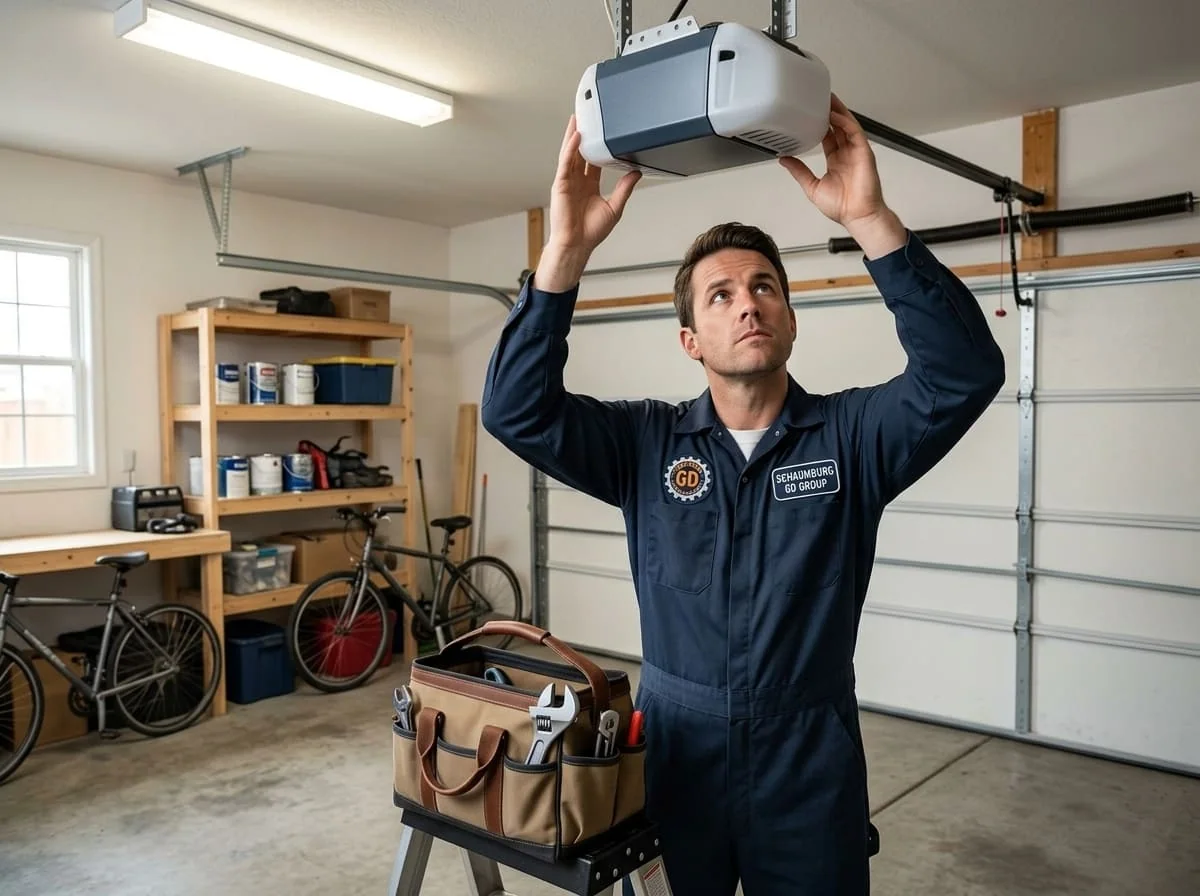
Why Drive Type Matters More Than Most Homeowners Think
When a customer calls me about a dead garage door opener, the conversation almost always jumps straight to horsepower or price. Those matter, but the decision that actually determines whether you're happy with the thing five years from now is drive type — chain, belt, or wall-mount. I've installed all three more times than I can count, in every kind of garage this area has: attached garages under a bedroom in Weathersfield, detached garages behind Olde Schaumburg bungalows, and tandem three-car garages out in the newer Hoffman Estates and Bartlett subdivisions. The right choice isn't the same for all of them.
Drive type refers to how the opener's motor moves the trolley that pulls your door open and closed along the rail. All three types I'll cover here use the same basic motor unit and safety systems — what changes is the mechanism doing the pulling. That mechanism is what drives noise level, price, ceiling clearance needs, and how the opener holds up over years of Illinois temperature swings. Get this part right and the opener disappears into the background of your life. Get it wrong and you'll hear about it every single day, usually early in the morning or late at night.
If your opener has already failed and you need same-day help, that's a separate conversation — see our garage door opener repair page. This article is for the homeowners planning ahead, replacing an opener that's finally worn out, or building a new garage and trying to make a smart call before the drywall goes up.
Chain-Drive Openers: How They Work
Chain-drive is the oldest and still the most common drive mechanism I install. A metal chain, similar in concept to a bicycle chain but heavier-duty, runs the length of the rail and pulls the trolley that connects to your door's arm. The motor turns a sprocket, the chain moves, the door goes up or down. It's a mechanically simple system, which is exactly why it's been around since garage door openers became a residential product.
The strength of chain-drive is raw pulling power and durability. Metal-on-metal transfer of force doesn't stretch or degrade the way a rubber belt can, so chain-drive units handle heavy doors — thick insulated sectional doors, oversized double doors, doors with a lot of ornamental hardware weight — without strain. They're also the least expensive option up front, which is why they remain the default choice builders spec into new construction across the northwest suburbs.
The tradeoff is noise. Chain against a metal rail, running directly above a garage ceiling, transmits vibration into the framing of the house. If your garage sits under a bedroom, a home office, or a room where someone's trying to sleep while a teenager leaves for an early shift, that clatter is noticeable. It's not a defect — it's just physics. I still install plenty of chain-drive units, especially in detached garages and garages that don't share a wall or ceiling with living space, because for those situations the noise simply doesn't matter and the extra strength and lower cost make sense.
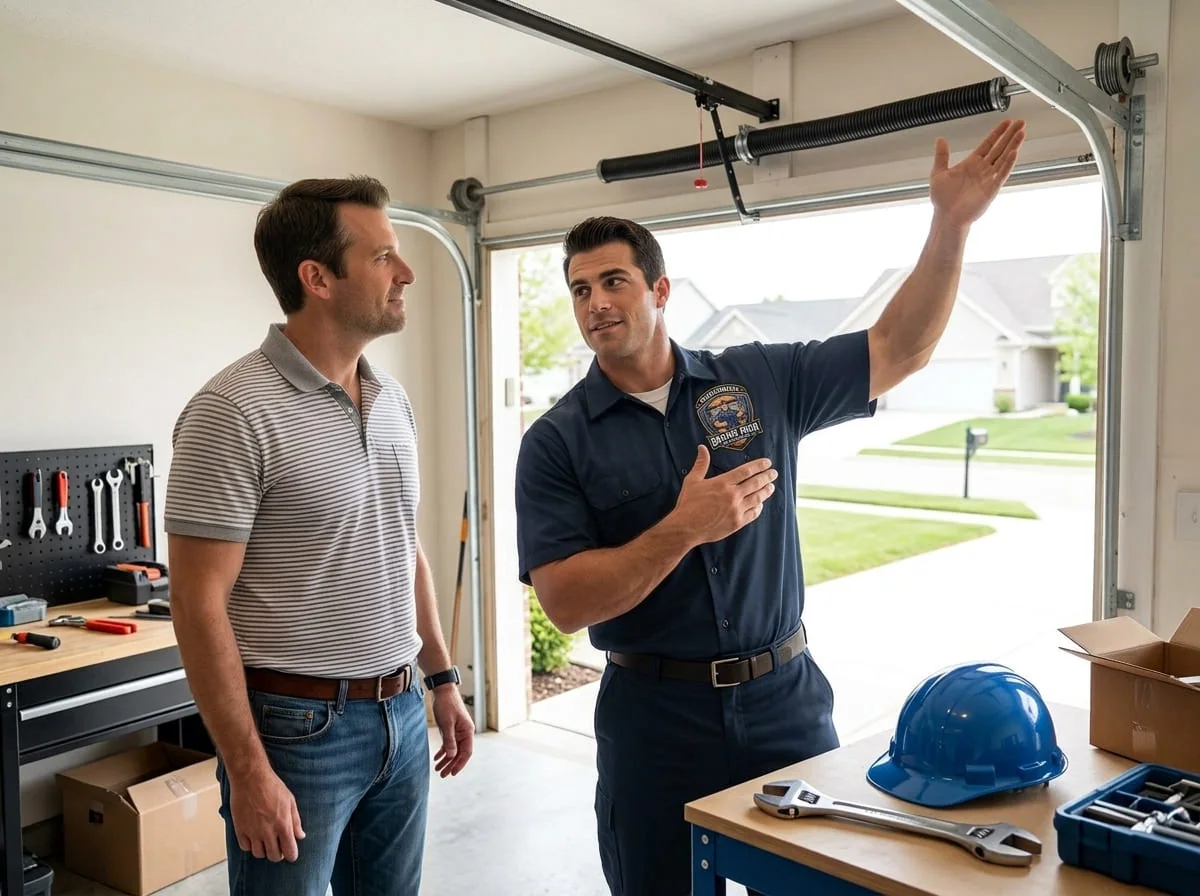
Belt-Drive Openers: How They Work
Belt-drive openers use the same rail-and-trolley concept as chain-drive, but the chain is replaced with a reinforced rubber or polyurethane belt, often with a fiberglass or steel cord core for strength. The belt runs quieter than a chain for a simple reason — rubber absorbs vibration instead of transmitting it through metal.
This is the opener I recommend most often for attached garages here in Schaumburg, particularly in Weathersfield and International Village where a lot of homes have a bedroom directly above or beside the garage. The noise difference between chain and belt isn't subtle — it's the difference between a door that wakes up the house and one that barely registers. Belt-drive units have gotten strong enough in recent years to handle most residential doors, including insulated doors, without the power gap that used to exist between belt and chain options.
The tradeoffs are cost — belt-drive units typically sit at a step up in price from equivalent chain-drive models — and, at the extreme heavy end, some very large or very heavy custom doors are still better served by chain-drive's raw strength. For a standard single or double garage door on an attached garage, though, belt-drive is usually my default recommendation once a customer tells me noise is a concern.
Wall-Mount (Jackshaft) Openers: How They Work
Wall-mount openers, sometimes called jackshaft openers, work completely differently from the first two. Instead of a rail running along your ceiling, the motor mounts on the wall beside the door and connects directly to the torsion spring shaft. Turning that shaft winds and unwinds the springs, which raises and lowers the door — there's no overhead rail at all.
The big advantage is ceiling clearance. If you've got a garage with a low ceiling, exposed ductwork, storage shelving, or a car lift, a wall-mount opener frees up that entire overhead space. I install these often in garages that double as workshops, or where a homeowner wants a gym setup or hanging storage racks and simply doesn't have the eight-plus inches of clearance a standard rail system needs above the door track.
Wall-mount units also run quiet, since there's no chain or belt running the width of the garage, and they tend to be very reliable mechanically since the moving parts are consolidated at one point rather than spread along a rail. The downside is they require the door to have working, correctly-sized torsion springs already in good shape, since the opener depends entirely on the spring system to do the heavy lifting — the motor is really just replacing your hand on the spring shaft. That makes wall-mount a poor fit for a door with worn-out or undersized springs unless you address the springs first; see our spring repair page if you're not sure what shape yours are in, or read our breakdown of torsion vs. extension springs for background on why spring type and condition matter here. Wall-mount units also tend to cost more than a comparable chain or belt system and, on some door configurations with limited side room, may not have a spot to mount at all.
Comparing Noise, Power, and Ceiling Clearance
Customers usually want the short version, so here's how I'd lay it out side by side based on what I actually see in the field:
| Factor | Chain-Drive | Belt-Drive | Wall-Mount |
|---|---|---|---|
| Noise level | Loudest | Quiet | Quiet |
| Upfront cost | Lowest | Moderate | Highest |
| Raw pulling power | Highest | High | Depends on springs |
| Ceiling clearance needed | Standard rail | Standard rail | None — frees ceiling |
| Best fit | Detached garage, budget priority | Attached garage, bedroom above/beside | Low ceiling, workshop, storage-heavy garage |
None of these is universally "better" — they're solving different problems. A homeowner in a detached garage in Elk Grove Village with no adjacent living space has no real reason to pay more for a quiet belt-drive unit. A homeowner in a Hoover Park split-level with a bedroom over the garage has every reason to. And a homeowner converting a garage bay into a home gym or workshop in Rolling Meadows or Palatine might value the wall-mount's open ceiling more than either noise or price.
Battery Backup and Smart Features Across All Three
One thing that surprises people is that battery backup and smart connectivity aren't tied to drive type — you can get a chain-drive, belt-drive, or wall-mount unit with either feature, or both, or neither. Battery backup keeps the opener functional during a power outage, which matters more here than people expect. We get enough summer storm-driven outages and winter ice-related grid issues in this part of Cook and DuPage County that a battery backup unit has genuinely saved customers from being stuck unable to get a car out. It's a feature I'd encourage almost anyone to consider regardless of which drive mechanism they pick.
Smart connectivity — the ability to check door status or open/close it remotely from a phone app — is now available across nearly every price tier and every drive type. I'd treat it as a nice-to-have layered onto your drive-type decision rather than a factor that should drive the decision itself. Get the mechanism right for your garage and your household first; the smart features are the same regardless of what's pulling the door.
Matching Drive Type to Your Door and Household
Here's the practical checklist I actually walk through with customers:
- Is there living space above or beside the garage? If yes, belt-drive or wall-mount. Chain-drive noise transmission is the single biggest source of opener-related complaints I hear about after the fact.
- Is the door heavy — thick insulated panels, oversized double door, decorative overlay hardware? Chain-drive still has an edge for raw strength, though modern belt-drive units have closed most of that gap for standard residential doors.
- Is ceiling space at a premium — storage racks, a car lift, low ceiling joists? Wall-mount is worth the extra cost, provided your torsion springs are in solid shape.
- Is budget the primary driver? Chain-drive remains the least expensive option and is still a perfectly good choice for garages without noise-sensitivity concerns.
- Do you want backup power during outages? That's an add-on decision layered on top of drive type, not a reason to pick one mechanism over another.
I'd also factor in how the door is used day to day. A garage that's opened once or twice a day for a car is a very different situation from a garage door that's cycled a dozen times daily because it's the household's main entrance — heavier daily cycle counts favor investing in a more robust drive system regardless of type, since more cycles means more wear.
Installation Considerations and Safety Standards
Whichever drive type you land on, the opener has to be installed to the door manufacturer's force and travel-limit specifications, and it has to include working photo-eye safety sensors near the floor on both sides of the door — that's not optional and it's not something a reasonable installer skips. If you want the background on how those sensors work and why they sometimes need adjustment, I've got a full breakdown on our safety sensor troubleshooting post. The Consumer Product Safety Commission has documented real entrapment injuries tied to improperly maintained or bypassed safety sensors over the years, which is part of why we take sensor alignment seriously on every install, not just the ones where a customer asks about it.
The garage door and opener industry publishes technical standards through the Door and Access Systems Manufacturers Association, covering everything from spring cycle ratings to opener force limits, and those standards are what responsible installers build their work around rather than guessing. Electrical work around the opener — the dedicated outlet, GFCI protection in a garage environment — should also follow National Fire Protection Association electrical code guidance, since garages are damp, temperature-swinging spaces where that protection actually matters.
If you're installing a wall-mount unit specifically, get your torsion springs inspected first — an undersized or worn spring set will make even a good jackshaft opener struggle and wear out faster than it should. We cover that inspection as part of every opener installation we do, and if your existing door has other issues — worn rollers, a track that's drifted out of alignment — those are worth fixing at the same time rather than mounting a new opener onto a door that's already fighting itself; see our track repair page if that sounds familiar.
How I Actually Recommend an Opener
When I'm standing in someone's garage doing the actual quote, I'm looking at four things: what's on the other side of that garage wall or ceiling, how heavy and how old the door is, whether ceiling space is spoken for, and what the household's budget priority is. Nine times out of ten those four answers point clearly to one of the three drive types before we even get to brand or feature comparisons. I'd rather spend ten extra minutes walking through that with a customer than sell whatever's sitting on the shelf, because an opener that's wrong for the garage it's in becomes a complaint call within a year — and I'd rather not get that call, and you'd rather not make it.
If your existing opener is already causing problems — not closing all the way, reversing for no reason, making a grinding noise — that might be a repair rather than a replacement decision, and it's worth a look before you commit to a new unit. Our door won't close troubleshooting guide covers the most common culprits, and regular upkeep on the drive system you already have goes a long way toward avoiding an early replacement — see our maintenance checklist for what that upkeep should look like. When it is time for something new, we're happy to walk your specific garage through this same decision process — reach out through our contact page and we'll set up a free upfront quote with no pressure toward a particular option.

Craig Halvorsen
Owner and lead technician at Schaumburg Garage Door Repair Group, serving Schaumburg, IL since 2011.
FAQs
Is a belt-drive opener really worth the extra cost over chain-drive?
If your garage shares a wall or ceiling with living space, yes — the noise difference is significant enough that most homeowners notice it immediately and are glad they paid for it. If your garage is detached or isolated from living space, the extra cost buys you less practical benefit.
Can I put a wall-mount opener on any garage door?
Only if the door has a working torsion spring system in good condition, since a wall-mount (jackshaft) opener drives the spring shaft directly rather than pulling the door along an overhead rail. Doors using extension springs or doors with worn, undersized, or mismatched springs typically need spring work done first before a wall-mount unit makes sense.
Does drive type affect how long the opener lasts?
Drive type affects wear patterns more than overall lifespan. Chain-drive systems can wear a rail over many years of use; belt-drive belts can stretch or wear over a very long service life; wall-mount units concentrate wear at the spring shaft coupling. All three, properly installed and maintained, typically give many years of reliable service.
Will a quieter opener also be weaker?
Not necessarily. Belt-drive and wall-mount units today are built with enough motor power to handle standard residential doors, insulated doors included. The strength gap that used to exist between chain and belt options has narrowed considerably. Very heavy or oversized custom doors are still where chain-drive keeps a clear power edge.
Do I need a battery backup opener in this area?
It's not required, but it's a feature I'd genuinely recommend. We see enough summer storm outages and occasional winter grid issues in the Schaumburg area that a battery backup unit has real practical value — it's available across chain-drive, belt-drive, and wall-mount options, so it's an add-on decision separate from drive type.
How do I know if my current opener problem is a repair or a sign I need a new drive type?
A single failure — a bad sensor, a stripped gear, a dead capacitor — is usually a straightforward repair. If you're dealing with chronic noise complaints, a door that struggles with weight it never used to, or a ceiling-space conflict, that's a sign the drive type itself may be wrong for your garage, and replacement with a different mechanism is worth considering.
Have a Garage Door Problem Right Now?
Skip the guesswork — call Schaumburg Garage Door Repair Group for a fast, honest diagnosis.